

What is Ayurveda? Is really a tough question to answer. The Ancient Indian system of health and medicine has many dimensions. From whichever angle we see it, Ayurveda gives a refreshing look. If we sit and analyze the depth and reach of Ayurveda, we can differentiate many aspects of Ayurveda into different categories. Here is a personal attempt to explain Ayurvedic medicine system.
Table of Contents
Different facets of Ayurveda
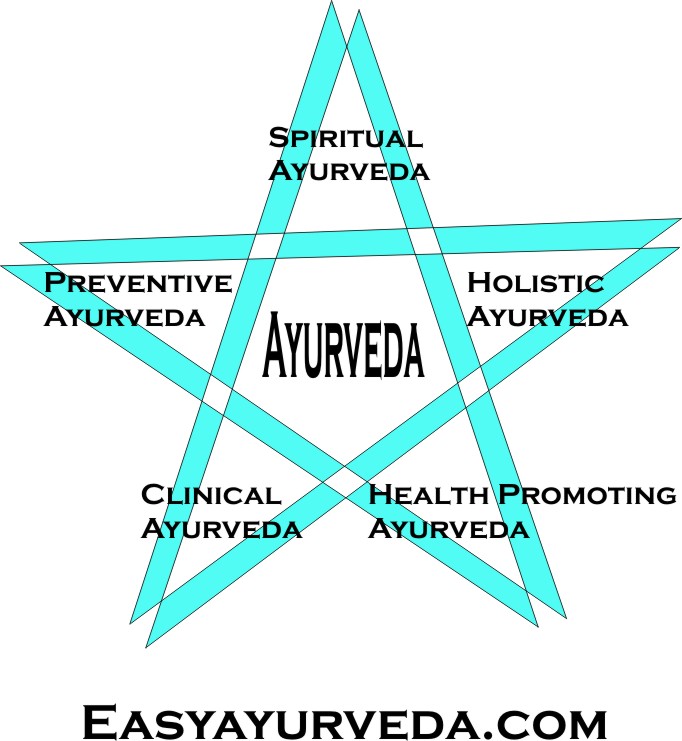
1. Spiritual Ayurveda
- Ayurveda has its roots deep in spirituality.
- Ayurveda tells us the very purpose of life, about the karma, why we take birth, various theories about the formation of this entire universe and the simple and humble ways of human existence.
- The origin of Ayurveda was to help people live long so as to follow righteous path.
- Many diseases like skin disorders are said to happen due to sin.
- In the Ayurvedic treatment of many diseases, like in selected types of fever, spiritual practices have been mentioned.
- In every ancient Ayurvedic text books, there is a separate chapter dedicated to righteous living. It is a well-known fact in Ayurveda that, as long as one is not mentally and spiritually healthy, one’s overall ‘health aspect’ is incomplete.
- Even in understanding health and disease, ancient Ayurveda scientists used to acquire the sacred knowledge of Ayurveda about health and disease through spirituality. Example: Sushruta used to do dissection of dead bodies to understand the anatomy and physiology of body thousands of years ago. He writes in a context – “The parts of body that can be seen through naked eyes are less, those that can not be seen are infinite. The knowledge of those unseen parts can only be had by the eyes of meditation and eyes of knowledge!”
2. Holistic Ayurveda
The health science that gave the concept of holistic approach to health and disease is Ayurveda.
In Ayurvedic treatment, Ayurveda gives importance to
- The strength of the disease,
- strength of the body of the patient
- Dosha body type of the patient
- Mental condition of the patient
While treating a patient, Ayurveda not only concentrates on just getting rid of the disease process or breaking the disease pathology. It tries to overall recovery of all the aspects of health – spiritual, mental and physical.
Even after the illness is completely cured, Ayurveda offers rejuvenation and aphrodisiac therapies so that the person can have superior health and enjoy life to its fullest.
3. Preventive Ayurveda
If you open any Ayurveda book, the first few chapters are dedicated to explain how your daily routine should be, how your seasonal routine and rituals should be, what are the techniques to secure and maintain good health.
There are two aims of Ayurveda.
1. To maintain the health of the healthy.
2. To treat the diseased.
So, preventive healthcare is considered ahead of curative aspect.
4. Curative aspect of Ayurveda
Set aside the aspects explained above, Ayurveda is a hardcore science of treating the disease. From the treatment of a simple fever to complicated cancers, Ayurveda books explain you volumes and volumes of treatment options.
Sushruta is considered as father of Surgery even by Allopathic fraternity. He used to do surgery of cataract, kidney stones, rhinoplasty (cosmetic surgery of nose) etc. 2000 years ago.
In general, Ayurvedic treatment comprises of
- Panchakarma – 5 sets of detox programs
- Ayurvedic medicines, herbs, remedies
- Diet and lifestyle, to follow and, to avoid, for quick relief from the disease.
- Rejuvenation program to gain back the original vigor and vitality.
5. Ayurveda for health promotion
This special section comprises of aphrodisiac treatment, geriatric treatment to have high quality marital and old-age life.
Pediatric rituals called Samskaras (rituals to be followed at different stages of child growth) and pregnancy care can also be included in this section. This section is to have enjoy the extra benefits of health to have a successful and wholesome life.
Addition by
By Dr Raghuram Y.S. MD (Ay) & Dr Manasa, B.A.M.S
Ayurveda is the oldest school of medicine ever known to mankind. The roots of Ayurveda are based in Vedas, most ancient treatises of comprehensive knowledge.
Vedas comprised of knowledge of everything, including medicine, lifestyle, creation, politics, economics, governance, worship, oblations and sacrifices given to God, agriculture and lot more. Vedas are four in number i.e. Rigveda, Yajurveda, Samaveda and Atharvaveda. Ayurveda is said to be branch and sister section of Atharvaveda.
Descent of Ayurveda
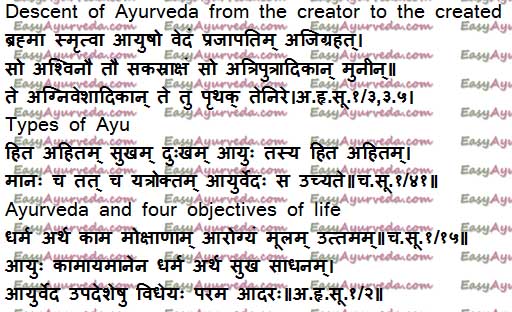
Ayurveda is said to have been created by creator, Brahma himself.
When the creator saw that his creation was suffering from many ailments and that they were not happy, he, with utmost compassion and love towards living beings recollected science of health and narrated it to Prajapati. The latter was creator’s representative who took care of smooth run of creation. ‘Recollection’ means something which already existed. Thus, Ayurveda was always there in mind of the creator and he narrated it only when he felt need to preach it.

Prajapati, manager of creation later preached Ayurveda to physicians of Gods i.e. Ashwini twins. Celestial twins further taught Ayurveda to Lord Indra, king of Gods.
Sage Bharadwaja, with an intention of finding suitable remedies so as to cure ailing mankind from clutches of diseases approached Lord Indra. Lord Indra conferred knowledge of Ayurveda to sage. Bharadwaja further propogated this divine health science to his disciples and colleagues. Knowledge never remained constant and was preached and taught through successive generations of students and aspiring physicians.
Ayurveda has ever since been selflessly involved in healing ailing mankind and is also a popular and most sought health system even in modern day. This timeless and ageless time-tested medical system has been accepted and embraced by modern world because it is natural, healing, and comprehensive.
Comprehensiveness of Ayurveda
Comprehensiveness of Ayurveda lay in it being both a preventive and curative medical science.
Ayurveda was the first medical system which emphasized on preventive medicine. The evidence for this is the detailed elaboration of daily and seasonal regimens, personal and community health. Ayurveda also has stressed upon role of dietetics, lifestyle modulations, body cleansing and consumption of rejuvenators and immune modulating medicines in contexts of treating each and every disorder.
‘Conscious avoidance of causative factors of a disease’ i.e. nidana parivarjana has been quoted as major part of treatment. Shat Kriya Kalas i.e. 6 stages of disease formation by Sushruta is one of best concepts of studying a disease pathology in different tiers of its development and has been embraced by other medical systems with evolutionary changes and change of terms as suited to their system. This allows studying diseases and identifying them in their earliest stage of manifestation which further enables early treatment of diseases and also in avoiding recurrence of diseases.
Curative package of Ayurveda deals with identification of disease and causative factors, isolation of latter, treating disease from base by breaking pathological process, administration of detoxifying treatments in form of cleansing treatments i.e. Panchakarama measures, giving disease modifying medicines, advocating suitable diet and lifestyle modifications and administration of immunity modulating medicines so as to prevent diseases from relapsing.
Introduction
Ayurveda is one of the world’s oldest holistic healing sciences. It is a traditional ancient Indian healthcare system which aims to attain a balance between the body, mind and spirit to promote health, prevent and cure diseases.
Ayurveda originated in India around 6000 BCE, during the Vedic period and was passed down from one generation to the next through an oral tradition, from an accomplished master to his disciple. Some of this knowledge was documented a few thousand years ago and is still accessible.
The word Ayurveda is derived from two Sanskrit words,
‘Ayu’ which means ‘life’ and
‘Veda’ which means ‘science’ or ‘knowledge’.
Hence the meaning of the word Ayurveda is ‘the science of life’.
Ayurveda is considered Upaveda of Atharva Veda (one among the 4 Vedas. Vedas are the oldest written documents explaining about science and society)
Basic operational strategy of Ayurveda
Blueprint of operational strategies of Ayurveda as a health science is based on comprehensively addressing three vertices of health system governance known as trisutra. Three principles to be addressed so as to establish good and total health in a given person individually or in a given population at a gross level are –
- Hetu – identification and isolation of causative factors of a disease
- Linga – knowing a disease in its entirety by identifying its signs and symptoms (diagnosis)
- Aushadha – treating disease comprehensively after properly diagnosing it and also to see that it doesn’t relapse in a later part of time
Meaning and Definition of Ayurveda
Word Ayurveda is made up of two terms i.e. Ayu and Veda.
‘Aayushah vedah Ayurvedah’
- Ayu means life, lifespan
- Veda means knowledge, wisdom
Thus, Ayurveda is ‘knowledge of life’ or ‘knowledge of lifespan’.
General meaning of ayu is lifespan, but meaning is more than that. Ayu is said to be a combination of body, soul, mind and senses. Thus, ‘coexistence of body, soul, mind and senses’ is ayu. Knowledge which is helpful in maintenance of integrity and coexistence of these four entities without any obstacles in form of disease or damage is named Ayurveda.
Thus, Ayurveda, by providing comprehensive knowledge about preventive and curative aspects of medicine will help in guarding integrity of chain of body, soul, mind and senses which constitute us, our lifespan.
Word veda is derived from root term ‘vid’. Vid means ‘to know’. This term vid has many meanings.
- Vid jgnane – to know and understand
- Vid labhe – to obtain
- Vid aishvarye – to enhance or enrich, treasure
When we apply these meanings to Ayu and try to understand word Ayurveda as a whole we learn that ‘ science which helps one to know and understand lifespan constituting amalgamation of body, soul, mind and senses, to obtain a qualitative and quantitative lifespan and to enrich one’s treasure in terms of health and wellbeing is called Ayurveda’.
To sum up –
‘ science which helps in obtaining knowledge of components which make up one’s life or lifespan, to understand quality and quantity of lifespan, enables one to enrich his lifespan and obtain longevity is called Ayurveda’
Types of Ayu
Ayu is of four types, i.e.
- Hita Ayu – advantageous lifespan
- Ahita Ayu – Disadvantageous lifespan
- Sukha Ayu – Happy lifespan
- Dukha Ayu – Unpleasant / Miserable lifespan
Ayurveda can also be defined on basis of these types of lifespan.
‘Ayurveda is a treatise in which beneficial and non-beneficial aspects of four types of lifespan i.e. advantageous, disadvantageous, happy and miserable lifespan and quantum and quality of lifespan have been elaborated.’ – Charaka
Four objectives of life
One needs to fulfill four objectives of his or her life during a lifetime. They are –
- Dharma – to conduct oneself in doing righteousness
- Artha – earning wealth and all good things
- Kama – desires conducive to oneself, his family and community in which he lives
- Moksha – focusing on getting liberated from vicious cycle of life and death and doing deeds in accordance to achieve salvation
To achieve these objectives of life, one needs to have good health and longevity. Ayurveda and preaching related to health and living embedded in its scriptures will enable one to lead a healthy life and also have a lengthy lifespan. This will enable him to achieve the four objectives of life and make his living meaningful. Thus Ayurveda enables one to achieve his or her life objectives which are termed as ‘purusharthas’.
Branches of Ayurveda
Eight branches of Ayurveda has been described –
1. Kaya Chikitsa – General medicine,
2. Bala Chikitsa – Paediatrics,
3. Graha Chikitsa – Demonology,
4. Urdhwanga Chikitsa – ENT, Ophthalmology,
5. Shalya Tantra – Surgery, cautery and bloodletting etc,
6. Damshtra Chikitsa – Toxicology,
7. Jara Chikitsa – Geriatrics, rejuvenation treatment and
8. Vrisha – Aphrodisiacs.
Although Ayurveda has been practised in India for a long time and is a part of the Indian tradition, it has recently gained popularity in the West as an alternative system of medicine.
Objectives of Ayurveda
The objectives of Ayurveda have been divided into two aspects namely:
1. Maintaining the health of a healthy person – Swasthasya Swathya Rakshanam
2. Treating the disease in the diseased – Aturasya Vikara Prashamanam.
The basic principles of Ayurvedic medicines deal with universal interconnectedness, the body’s constitution, and life forces.
Universal inter-connectedness – According to Ayurveda principles, the universe is made up of five basic elements – earth, water, fire, air and ether. Everything in the universe, living or non-living, are all formed as a result of combination of these 5 elements.
Body constitution – This system believes that each individual has a unique constitution (prakriti) which is determined at the time of conception. So it considers each individual to be different – mentally and physically. The diet, lifestyle and treatments vary from person to person, based on his body type. The body constitution is believed to be unchanged over a person’s lifetime.
Life forces – Like the world is governed by the forces of air, sun and water, the body and its functions are governed by 3 factors called Doshas – Vata, Pitta and Kapha. These are considered as the building blocks of the body. The balance of these three Doshas lead to health and its imbalance leads to disease condition.
Theories of Ayurveda
Ayurveda, at its core has the below-mentioned theories:
1. Tridosha theory – Like the air, sun and water control the world, the Tridoshas – Vata, Pitta and Kapha control the human body and mind.
2. Sapta Dhatu theory – seven tissues which form the framework of the body
3. Trimala – three waste products, which should be eliminated from time to time so as to maintain health.
4. Agni – digestion and metabolism strength, which is responsible for converting food into energy and to supply nutrition to all the seven body tissues. Agni, like the seven tissues, is influenced by the three Doshas.
5. Srotas – channels of the body through which fluids, food, nutrition, oxygen, tissues and waste products flow.
6. Spiritual concepts involving mind, soul, Satva, Rajas, Tamas etc.
Based on the above theories,
treatments are formulated.
Blueprint of operational strategies of Ayurveda as a health science
is based on comprehensively addressing the three vertices of health system
governance known as Trisutra. Three principles to be addressed so as to
establish good and total health in a given person individually or in a given
population at a gross level are –
- Hetu – identification and isolation of causative factors of a disease
- Linga – knowing a disease in its entirety by identifying its signs and symptoms (diagnosis)
- Aushadha – treating disease comprehensively after properly diagnosing it and also to see that it doesn’t relapse in a later part of time
To understand Hetu (causes) and Linga (symptoms of diseases),
Ayurveda has postulated
Pancha Nidana theory and Shat Kriya Kala theory.
Pancha nidana theory: 5 steps of
disease explanation
Nidana
– physical and mental causes of disease
Poorva Roopa – prodromal symptoms of the
disease
Roopa – signs and symptoms of the disease
Upashaya – alleviating and aggravating factors of the disease
Samprapti – complete story of how diseases progresses from Dosha vitiation to
complete manifestation of signs and symptoms.
Shat Kriya Kala – are the six stages, through with the Doshas pass through to get imbalanced and to cause disease.
Based on the Doshas causing disease, Ayurveda has three ways of treatments:
Shamana – alleviating the imbalanced Doshas. It is done with massage, sweating etc therapies and also with oral Ayurvedic medicines.
Shodhana – eliminating toxic Doshas out of the body
Swastha Hita – treatment to maintain health of healthy individuals.

All Ayurvedic treatment measures are based on the basic philosophies of Doshas, Dhatu, Agni etc. Hence, they are very important for an Ayurvedic clinician.
Ayurveda treats not only the human body, but also the mind. Hence, it is very important for the Ayurvedic practitioner to learn about the nature, qualities of mind, functions, afflictions with Rajas, Tamas etc.
All in all, without learning the basics of Ayurveda, in terms of Doshas, Dhatus, mind, soul, etc, one cannot become a successful Ayurvedic practitioner.




54 comments on “What Is Ayurveda? 5 Dimensions Of The Ancient Indian Health Wisdom!”
Dr.Megha Tyagi
This is a very good and complete explanation about ayurveda.
Dr J V Hebbar MD(Ayu)
Many thanks Dr Megha Tyagi. 🙂
Marshall Fonseka
I am glad to know him even at this late age.Marshall.
sandhya kelkar
realy sir it is a awesome topic it is a great knowledge indeed thanx for such a article looking forward for more articles abt ayurveda medi science keep up ur gud work
Dr J V Hebbar MD(Ayu)
Thank you very much 🙂
Dr.K.Kadavul
Thank U very much since I am teaching Medical Botany for both UG and PG levels I focus the importance of the Ayurvedha..
Dr J V Hebbar MD(Ayu)
Dear Dr Kadavul, Many thanks for appreciating my work. Best regards, Dr Hebbar
babu sadanand
Thank you Dr for your kind explanation
Dr J V Hebbar MD(Ayu)
Welcome
MANOJ SWEENARAIN
I would like to thank you very much for the clear explanation given.I am for ayurvedic medecine and respect at the same time allopathy.I think there is a need for a global campaign in informing the world about taking this natural medecine instead of the modern one composed of many chemicals which are causing more damages to the body by their side effects.
Dr J V Hebbar MD(Ayu)
Thank you very much sir. I am trying to spread the same awareness in the public mind, through this internet medium 🙂
Dr J V Hebbar MD(Ayu)
This topic will come up in a future article. Thanks for the suggestions.
SATISH AKUT
SATISH AKUT January,04,2014
Thanks for the informative article.Keep on providing more such information on Ayurveda which is a subject of my curiosity
Dr J V Hebbar MD(Ayu)
Thanks! I will sure do that.
Dr J V Hebbar MD(Ayu)
Dear Ashok, Nice to know about your healthy routine. Wish you good health.
Sulabha yajurvedi
I liked u r personal presentation of 5 aspects. Am am an avid reader and follower of ayurveda principles. But I am little disappointed with the treatment options ayurveda has on thyroid. Pl throw some light on the sub about u r experience
Sulabha yajurvedi
Dr yamuna
I would like to thank you very much for your explanation about ayurveda…
Dr J V Hebbar MD(Ayu)
Dear Dr Yamuna, greetings and thanks.
Suresh Kumar
Thanks to send me the notes of Ayurveda. It is very usefull knowledge now a days because people fadeup from alopathy.
Dr J V Hebbar MD(Ayu)
welcome 🙂
Jayvanthy Hattangdi
Congratulations on your sincere effort at Promoting better understanding of Ayurveda through the internet.
We in India have such a wonderful natural medicine system in Ayurveda, but it is not understood by most Indians. As a result I find that many Ayurvedic Doctors tend to give Allopathic medicines — very sad indeed.
I hope and pray that You are successful in your efforts. May the Supreme Power be with you in this endevour
Dr J V Hebbar MD(Ayu)
Thank you very much for your kind wishes.
I have resigned from my Associate Professor job to invest full time into this blog. Hope it will push some people towards positive health. 🙂
Minaz
Great work doc. Your blog is very informative, thanks for spreading the knowledge. Minaz
Dr J V Hebbar MD(Ayu)
Thank you very much 🙂
Raghupathy
Many thanks for your E mail. It is very useful and I understand the need to know oru body.thanks a lot
Dr J V Hebbar MD(Ayu)
Welcome
Abhijit kumar deb
The explanation of Ayurveda is wonderful,thank you very much for sharing your knowledge . God bless you
Vd Vijaydutt M V
Thanks for mind touching explanation.Why don’t you start blog for Ayurveda practitioners in guiding them in routine practical problems?
Dr J V Hebbar MD(Ayu)
Thanks for advice.
It will be a too big a task for me to teach Ayurvedic practitioners. I myself am not a that big guy.
R P Saxena
Dr Hebbar ,
Information given in your articles are very concrete and I hope these articles will remove all the doubt’s of Ayurveda in general public . Also hope that these articles will be a your’s great contribution towards Ayurveda and in exposing essential fact. Thanks a lot .
Shakeel Syed
Right now I am undergoing treatment for my shoulder pain in Ayurveda section of CGHS and I found that the treatment is really doing wonders . Your question and answers are very inspiring. I downloaded your book online It is amazing. Thanks for enlightening on the subject.Shakeel Syed
Dr J V Hebbar MD(Ayu)
Congratulations for quick healing with Ayurveda.
Thanks for subscribing to my website. 🙂
Gopi Shastri
volumes in a nutshell.Very informative.love to read more and more about Indian medicine
Hera
Hera Sonan:-
I am great admire of Ayurveda treatment because:-
(1) The treatment and the medicines which did not help me curing my UN- Diogenes sickness was cured by Ayurveda’S simple treatment.
(A) I was 16 years old when we were in Africa. All of a sudden,heavy fever caught me, the body was paining with burning sensation tremendously which continued for about a month. One French Doctor Mr.Iavan Faradi,who had a degree of MRCP from Uk was treating me,he was a very kind hearten doctor of about 45+ age.He tried his level best by referring the case to number of medical hospitals,doctors and institutions. But all in vain.Mean while one person from India (who’s name was Thiru Parthasarathy,he was on deputation invited by Indian Embassy in that country) voluntary came to our house and asked my parents to permit him to examine me. He gave us one months medicines (powder and lehas to be consume with honey.Miraculously,the medicines worked on me, within eight days the burning sensation and pain of my body started reducing down and by the end of the treatment I was up again as a normal young boy. since than I don’ have any health related problem so far. Since Mr. Parthasarathy was on deputation,he left the country with in four days.Before leaving,he left the massage with Indian embassy officials to continue medicines for one month .My parents spent huge amount in allopathy medicine but there was no sign of relief .But with Ayurveda powder and Lehas,it cured by problem from it root cause.Mr. Thiru Parthasarathy did not charge a single penny from us and on the contrary he blessed me to get cured fast. “SO THIS IS AYURVEDA”
(B) Recently my mother(80) met with an accident.which resulted into multipal fractures.Operations were performed and she was OK.But while at hospital within six days after operations,she suffered sivior paralysis st rock and she slipped into “COMA” her “COMA” status continued for 23 days.Neurologist gave treatment but every passing day her condition was turning bad to worst. Doctors gave up hopes. Meanwhile,we started contacting eminent doctors from Siddha, Ayurveda,Unani, Homeopathy and Tibetan system of medicines. After contacting the eminent doctors from all these systems of medicines, we choose Ayurveda and shifted my mother from Allopathy hospital to Ayurveda hospital. They started treating her with different types of therapies and medicines.Within five days she started some movements.After eight days of treatment she was compliantly out of “COMA” status. and by the time we were allowed to discharge, she was able to walk with support and she was able to make us understand that what she wants and she was able to grasp what we were telling her. It’s now five years passed,she is fine however weakness on her right side is not compliantly subsided and speak with “lure” tong but she is now totally independent and able to carry out her own work by herself.”SO AYURVEDA IS AYURVEDA’
habbibeaman
Dear Sir Doctor,
My first step of learning about ayurveda starts at age of 50 , many thanks for you doctor.
Dr.santosh kumar mishra
Thank u very very much….for very knowledge fulk explanation about ayurveda….thanks n goodwishes to carry on..
Dr J V Hebbar MD(Ayu)
Dear Dr Santosh, Greetings! Thanks for your kind words of appreciation. 🙂
Sujatha
Dear Mr.Hebbar
the information provided in your articles are very useful and execellant. you are in Mangalore , I hope that you may know Dr.Ravishankar who is my known to me.
Your work is execellant. God bless you in your efforts.
If you need any help from I am greatful to you.
Dr J V Hebbar MD(Ayu)
Dear Sujatha,
Greetings! Being a less social person, I do know Dr Ravishankar.
Thanks and regards 🙂
ashwini
Very informative article, which clears the misconception about Ayurveda
savita
good one…….. I need to treat my family by ayurveda….. ayurveda in daily life…..
K.Prafulla Chandra
a very simple and lucid explanation of 5 dimensions of Ayurveda.
Prafulla chandra
N.Girish
The requirement of the nation today is a holistic ,affordable health system, rooted in our cluture and not too alien to it, and adaptable by us. Ayurveda has a great role in this. Some years ago, the Hindu had started an exercise in which medical discussions took place amongst a group of doctors of different systems ie , Allopathic , Ayurvedic ,and Homeopathy wherein these experts discussed the optiions and philosophy of treatment of a particulat illness . Hope that Dr Hebbar can strive to take the lead again, in a similar holistic endeavour ,with the visual media ie TV also.
Dr J V Hebbar MD(Ayu)
I will try 🙂
Dr.Anushiya
Thank you Dr. it is a good article.
Dev
My spam come out when i go toilet
I can use makardhwaj tablet for this?
Dr J V Hebbar MD(Ayu)
No.
Soobadra Dhunoo
Very interesting information about ayurveda.
Thank you very much
Soobadra Dhunoo
I would like remedies for diabetes
Dr J V Hebbar MD(Ayu)
Please read here
https://www.easyayurveda.com/2013/11/25/madhumeha-ayurvedic-understanding-diabetes-mellitus/
Subhash
awesome, explained Ayurveda in a simple way
Olylove
Indeed, knowledge is power. Thank you so much for such wonderful and deeper insight you have made known to the public. Honestly I am over whelmed by the quality of knowledge work done l. 🙏
Dr J V Hebbar MD(Ayu)
Thank you 🙂