

Eating not only nourishes the body but also the mind. Following simple eating rules make eating a lot more enjoyable and beneficial. Here are a few healthy eating rules.
Table of Contents
Healthy eating rules
Don’t watch TV while eating.
No facebook / twitter / snapchat / whatsapp while eating.
No smartphone/ tablets while eating.
No texting messages while eating.
No phone calls while eating.
Do not eat hurriedly.
Eating together with your family, at least at night or at least once a week.
No junk stuff or aerated drinks with food.
No anger, no sad feelings, no depressed mood while eating.
Do not talk while eating.
Avoid negative feelings and talks.
Avoid disrespecting food.
Do not waste food.
Chew food well before swallowing.
Try drinking water in between meals.
How to eat food?
What is the authentic Ayurvedic procedure to eat food?
Food intake is more than just ingesting a few nutrients for our daily needs. Ayurveda believes in the below quote from Taittiriya Upanishad –
अन्नं ब्रह्मेति व्यजानात्। अन्नाद्ध्येव खल्विमानि भुतानि जायन्ते। अन्नेन जातानि जीवन्ति।
annaṃ brahmeti vyajānāt| annāddhyeva khalvimāni bhutāni jāyante| annena jātāni jīvanti|
Meaning –
annāt eva khalu imāni bhutāni jāyante – with Anna – food itself, all the living beings take birth
annena jātāni jīvanti – with food itself, all beings continue to live
annaṃ brahmeti vyajānāt – Hence, food itself is equivalent to Brahma – the creator God.
So, because the food has such a high spiritual, physical, medical and therapeutic significance, Ayurveda gives immense importance regarding how the food should be consumed.
Acharya Sushruta has explained the process of food intake in Sushruta Samhita, Sutrasthana 46th chapter,
सुखमुच्चैः समासीनः समदेहोऽन्नतत्परः |
काले सात्म्यं लघु स्निग्धमुष्णं क्षिप्रं द्रवोत्तरम् ||४६५||
बुभुक्षितोऽन्नमश्नीयान्मात्रावद्विदितागमः |४६६|
sukhamuccaiḥ samāsīnaḥ samadeho’nnatatparaḥ |
kāle sātmyaṃ laghu snigdhamuṣṇaṃ kṣipraṃ dravottaram ||465||
bubhukṣito’nnamaśnīyānmātrāvadviditāgamaḥ |466|
sukham – one should sit comfortably
uccaiḥ – on an elevated place (such as a mat)
samāsīnaḥ – sitting on an even place with comfort
samadeho – the body in a good balance (neither tilting to left or right), annatatparaḥ – should concentrate on the food on the plate. One should not have lust, anger, greed etc. unwanted feelings in his mind while having food, if not these feelings will get amplified by the food consumed.
kāle – the food should be as per the season and as per the time of the day, considering complete digestion of previously consumed food
sātmyaṃ – food should be congenial, if the person carries an illness, then the food should be as per the diet advised for that disease,
laghu – light to digest
snigdham uṣṇaṃ – unctuous and hot
kṣipraṃ – that is served properly, should be eaten at a good pace, without wasting time, neither too fast, nor too slow,
dravottaram – food should be moist or food should be consumed with some amounts of liquids such as water, soups, broth etc. It should not be totally dry, solid foods
bubhukṣito annam aśnīyāt – Food should be consumed when the person is totally hungry
mātrāvat – should be consumed in proper quantities
viditāgamaḥ – should be consumed with proper procedure (sweet, sour, salt, pungent, bitter and astringent tastes, consumed in that order, with water, soup, etc. in between and so on), should be consumed by thoroughly enjoying the food by all sense organs, by smelling, seeing, touching the food, etc.
Eating while watching smartphone makes you eat more (1)
Ideal food quantity
Stop eating before full stomach. As per Ayurveda, heavy food that take long time to digest should be consumed till half of the satiation level. Foods that are light to digest should be consumed just up to the stage of satiation. The right amount of food is that which undergoes digestion before the next meal time.

Ideally, two parts of the stomach (half of its capacity) should be filled with solid foods, one part by liquids and the remaining one part should be kept vacant for accommodating air.
Consuming a very less amount of food / continuous fasting will lead to depleted body growth, immunity and strength. Consuming excess of food causes indigestion, obesity and a host of related disorders.
Foods to be consumed habitually
Food that can be consumed habitually – As per Ayurveda, the following foods can be consumed habitually. Wheat, rice, barley,
meat of deer, pigeon, Jivanti herb, young radish, Amla, dry grapes, Pointed gourd, green gram, ghee, clarified jaggery, milk, honey, pomegranate, rock salt (Saindhava).
Foods not to be consumed habitually
Food that should not be consumed habitually are – dairy sweet products, curds, solid part of curds, Kshara (alkalis), fermented gruel, uncooked radish, meat of animals which are emaciated, dry meat, meat of boar, sheep, cow, fish and buffalo, black gram, germinated grains, dried vegetables, small variety of barley, half cooked molasses.
No curds at night. Have buttermilk instead.
No heavy sweets or oily food at night.
Eat 2 – 3 hours before going to bed.
If your meals contain sweets, better to eat it at the beginning.
Cold water is ideal to drink after consuming barley, wheat, curds and honey.
Warm water is ideal after consuming buttermilk, fermented gruel, dishes prepared with vegetables, green gram and other legumes.
If you have taken oily food, drink hot water and do not drink cold water
Ideal time for food intake
The ideal time for taking meals is after the elimination of faeces and urine, when the mind is clean, when the Doshas are moving in their natural paths, when belching is devoid of any foul smell or taste, when hunger is well manifested, when the flatus is moving downward easily, when the digestive activity is keen, when the sense organs are clear and functioning, when the body is light. Food should be consumed observing the rules and procedures of taking food.
Related article:
Follow Ayurvedic eating tips for good health

Charaka Samhita – Healthy eating rules
Healthy eating rules as per Charaka Samhita Vimana Sthana 1st chapter:
One should eat only that food in proper quantity which is hot, unctuous.
The food should not be contradictory in potency – Eg; mixing of cold ice creams with coffee (hot)
Food is taken in proper place equipped with all the accessories, without talking and laughing, with concentration of mind and paying due regard to oneself.
One should take warm food. When taken warm, it is delicious; after intake, it provokes digestion. The food gets digested quickly and helps in the downward passage of vata (wind) and detachment of Kapha. Therefore, one should take warm food.
Unctuous (oily) food:
One should take unctuous food; unctuous food is delicious, after intake, it provokes the subdued power of digestion; it gets digested quickly; it helps in the downward movement of Vata (wind) it increases the plumpness of the body, strengthens the body and improves complexion.
Intake after digestion of previous meal:
One should take food only when previous meal is digested. If one takes food before the digestion of the previous meal, the digestive product of the previous food, i.e immature rasa gets mixed up with the product of food taken afterwards, resulting in the provocation of all the Doshas instantaneously.
If food is taken after the digestion of the previous food while the Doshas are in their proper places and Agni (digestive enzymes) is provoked,
There is appetite
The entrances of the channels of circulation are open,
Eructation is purified
There is unimpaired cardiac function
Downward passage of the wind and
Proper manifestation of the urges for voiding of the wind and
Proper manifestation of the urges for voiding flatus urine and stool,
Then the product of food does not vitiate the Dhatus of the body, but on the other hand it promotes longevity in its entirety.
So one should take food only after digestion of the previous meal.
Intake in proper place and with all accessories:
One should take food in a proper place, equipped with all accessories. By doing so, there will be no emotional strain.
Intake not in hurry:
One should not take food too hurriedly. If food is taken too hurriedly it enters into a wrong passage and it does not enter the stomach properly.
Intake not too slow:
One should not take food very slowly because this will not give satisfaction to the individual.
Intake with concentration:
One should not talk or laugh or be unmindful while taking food. One taking food while talking, laughing or with detracted mind, will face the same trouble as the one eating too hurriedly. So one should not talk, laugh or be absent-minded while taking food.
Intake with self-confidence:
One should take food in a prescribed manner; with due regard to his own self. The knowledge of the usefulness or otherwise of food articles is the Sine Qua non for self- preservation. So one should take food in a prescribed manner with due regard to his own self.
The rules of food consumption or dietetic rules are called Upayoga Samstha. Upayoga Samstha forms a part of ‘Ahara Vidhi Vishesha Aayatanaani’ i.e. ‘Special conditions for intake of food’.
Related reading – Ahara Vidhi Vishesha Aayatanaani
Upayoga Samstha and Jeerna Ahara Lakshanas
Upayoga Samstha is totally dependent on the Jeerna Ahara Lakshanas i.e. symptoms of proper digestion.
Jeerna Ahara Lakshanas –
Below mentioned are the signs (features) of proper digestion.
- Udgara Shuddhi – Cleanliness of belching
- Utsaha – Enthusiasm
- Vega Utsarga – Proper evacuation of urges
- Laghuta – Lightness of the body
- Kshut – Manifestation of hunger
- Pipasa – Manifestation of thirst
Rules and Regulations for intake of food (Upayoga Samstha)
It is important to take the food which is wholesome and good for our body, for our health and for sustenance of life.
The rules and regulations for intake of ahara (food) are as enlisted below. They are applicable for both diseased as well as healthy people.
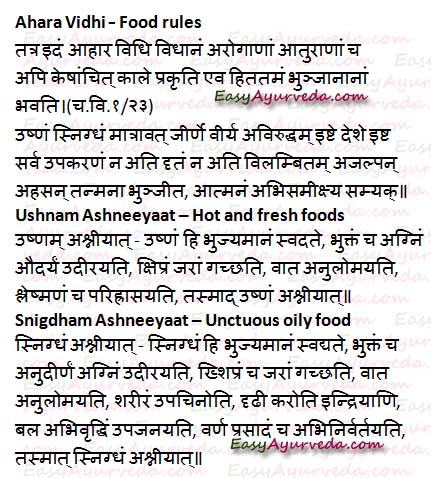
Proper quantity of food should be consumed while following the below mentioned rules as mentioned in Upayoga Smastha –
- Ushnam Ashneeyaat – Eat hot and fresh food
- Snigdham Ashneeyat – Eat unctuous food
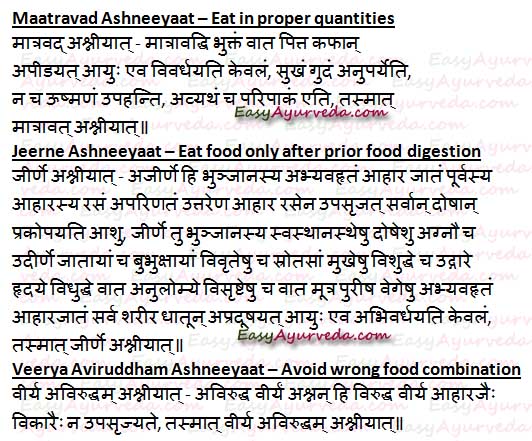
- Matravad Ashneeyaat – Eat according to proper quantity
- Jeerne Ashneeyaat – Eat after feeling hungry, after the digestion of previously consumed food
- Veerya Aviruddham Ashneeyaat – Eat food which is not contradictory in potency
- Ishta Deshe, Ishta Sarva Upakaranam Cha Ashneeyaat – Eat in a desired place with desired articles
- Na Ati Dhrutam Ashneeyaat – Do not eat in a hurry
- Na Ati Vilambitam Ashneeyaat – Do not eat very slowly
- Ajalpan, Ahasan, Tanmanaa Bhunjeeta – Eat with utmost concentration without talking or laughing
- Aaatmanam Abhisameekshya Bhunjeeta Samyak – Eat after self analysis
Ushnam Ashneeyaat – Eat the foods which are hot and fresh
All of us love to eat the food when served hot and fresh isn’t it? Yes, Hot and fresh food has a different appeal and life in it. It is instantly rejuvenating. The benefits of consuming hot food are as mentioned below –
- Ushnam hi bhujyamane swadyate – Hot food gives good taste, also enhances taste
- Bhuktam hi agnim audaryam udeerayati – Hot food increases the Agni or metabolic fire on entering the belly (stomach). This in turn sets right the metabolism, enhances appetite and capacity to digest food.
- Kshipram jaraam gachchati – Hot food gets easily digested.
- Vata anulomayati – Expels the vitiated Vayu, pacifies Vayu
- Shleshmanaam cha parihrasayati bhinna sanghaatam karoti – Reduces or destroys the vitiated Kapha and keeps it under balance
Snigdham Ashneeyaat – Eat the food which is unctuous
Unctuousness in the food is brought about by the addition of sneha or unctuous materials. These include taila (oil), sarpi (ghee), majja (marrow) and vasa (muscle fat). The benefits of consuming unctuous foods or snigdha ahara are as mentioned below –
- Snigdham hi bhujyamaanam swadhyate – Unctuous food is delicious, enhances taste
- Bhuktam cha anudeerya agnim udeeryati – Unctuous food kindles the digestive fire and enhances the capacity to digest
- Kshipram jaraam gachchati – gets digested quickly
- Vata anulomayati – pacifies vata
- Shareeram upachinoti – nourishes the body
- Drudhee karoti indriyaani – strengthens and stabilizes the sense organs and improves their perception power
- Bala abhivruddhim upajanayati – promotes and enhances strength and endurance
- Varna prasaadam cha abhinivartayati – helps in providing and enhancing color (and complexion)
Maatravad Ashneeyaat – Eat in proper quantities
Quantity of food varies from person to person and depends on one’s capacity to eat and digest. One should always eat food keeping the quantity in consideration. Over-eating and under-eating as per one’s capacity are both harmful for one’s health. The benefits of consuming food in proper quantity are as mentioned below –
- Matravaddhi bhuktam vata pitta kaphaan apeedayad ayuhu eva vivardhayati kevalam – Food taken in proper quantity will not disturb or aggravate the doshas, in fact it enhances the life quality and quantity (life span)
- Sukham gudam anuparyeti – easily passes down to the rectum
- Na cha ushnam upahanti – it does not impair the power of digestion
- Avyatham cha paripaakam eti – the food gets easily digested
The food when consumed in proper quantity at a proper time always enhances agni (power to digest food), i.e. increases digestion. It is also dependent on the nature of food consumed. The heaviness (guru) and lightness (laghu) of the food substances should be known and decided before consumption.
Guru ahara or heavy food should be consumed until one’s hunger is half satisfied, i.e. half of one’s capacity or half of one’s stomach’s capacity. Laghu ahara or light food should also not be taken in excess or up to the point of satiety.
Examples of laghu ahara or light food are – shali shashtika (rice or paddy grown in 60 days), mudga (green gram), lava (meat of ), kapinjala (meat of ), ena (meat of antelope), shasha (meat of rabbit), etc. These foods, in spite of being light in nature shall be consumed by taking quantity into consideration. They should not be taken in excess or beyond one’s capacity.
Examples of guru ahara or heavy foods are – pishta (flour products), ikshu (sugarcane), ksheera vikriti (milk and milk products), masha (black gram), anupa pishita (meat of animals and birds residing in marshy regions), audaka pishita (meat of aquatic animals) etc. Since these foods are basically heavy in nature, they should be taken in proper quantity, half of one’s capacity to be precise.
The basic criteria of looking into the quantity of consumed food is that the ‘food should be taken in a quantity which gets digested easily’.
Jeerne Ashneeyaat – Eat the food only after the food taken previously has been digested
One should consume food only after the previously taken food has been properly digested and the symptoms or features of proper digestion have appeared. If one happens to consume the food in spite of the previous food not being digested, the new food gets added to the undigested food (semi-digested) and form a vicious mixture. This will further aggravate the doshas leading to the manifestation of various diseases. Thus the food shall be consumed after the proper digestion of the previously digested food which is marked by the manifestation of hunger.
Benefits of eating the food after the previously taken food has been digested –
- Swasthanastheshu dosheshu agnau cha udeerne – doshas remain in their own sites without trespassing into other sites and kindles the digestive fire
- Jaataanaam cha bhubhukshaayaam – good appetite is manifested, enhances appetite
- Vivruteshu cha srotasaam mukheshu – the srotases or channels are cleansed and their openings at their origin get clear and dilated
- Vishuddhe cha udgare – the belching are clean and clear
- Hrudaye vidhuddhe – cardiac functions get going in an uninterrupted way, feel of cleanliness and lightness in the cardiac region (chest)
- Vata anulomye – vata gets subsided, expelled
- Visrushteshu vata mutra pureesha vegeshu – proper evacuation of flatus (fart), urine and faeces
- Ahara jaatam sarva shareera dhaatoon apradooshayad ayuhu eva abhivardhayati – the consumed food enhances the life span without vitiating or disturbing the tissues of the body
Veerya Aviruddham Ashneeyaat – Eat food which is not contradictory in potency
One should choose his or her food wisely such that one food is not contradictory to another food in terms of their potency. This means to tell that one should eat foods which are not contradictory to each other in potency or veerya.
Benefits of eating food which is not contradictory in potency –
Viruddha aaharajaihi vikaaraihi na upasrujyate – On consuming the foods which are mutually contradictory in terms of veerya or potency, one would surely suffer from many diseases in future. But when one consumes food which are not contradictory in potency he or she will be free from the risk of suffering from such diseases (caused due to veerya viruddha ahara i.e. foods contradictory in potency).
Example, one should not take milk and fish together. They are veerya viruddha aharas, i.e. they have contradictory potencies. Milk or ksheera is of sheeta veerya (cold potency) but fish or matsya is of ushna veerya (hot potency). When they are consumed mixed together their veeryas get contradictory and will have a dangerous impact on health. They will also cause diseases like rakta vikriti (blood contamination or vitiation), Kushta (skin disorders), napunsakata (infertility) etc. These diseases occur due to antagonistic or contradictory veerya in the milk and fish which do not form a compatible combination.
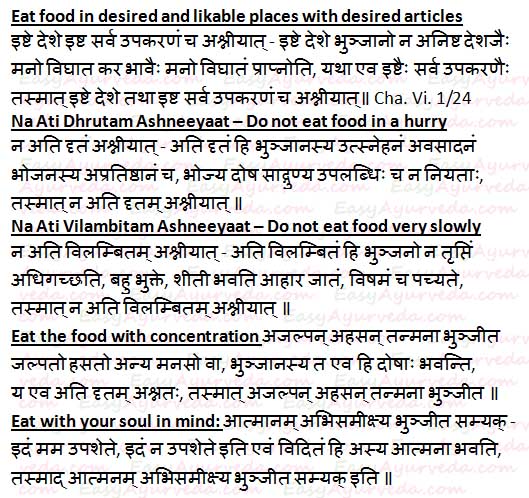
Ishta Deshe Ishta Sarva Upakaranam Cha Ashneeyaat – Eat food in desired and likeable places with desired articles
The place where we consume food is also important. It should be a lovable place, which we like very much, very much in sync with our emotions and compatible with us. If we have food in undesired places or places which cause aversion or those places we hate, the food doesn’t get digested, in fact it may produce severe aversion, nausea, vomiting, indigestion and many other diseases. Similarly we should have all the desired articles in the vicinity before we consume the food, including likeable dining table, seating, utensils etc. these things will produce pleasantness of the mind and create an ideal environment for food consumption. It also makes eating a pleasurable and lovable event rather than a formality. A pleasant mind can receive and digest food in a better way.
Benefits of taking food in desired places with desired materials –
Na anishta deshajaihi mano vighaat kara bhaavaihi mano vighaatam prapnoti, yatha eva ishtaihi sarva upakaranaihi – On consuming the food in desired and lovable place and in presence of desired materials, the mental instabilities and diseases which occur due to consumption of food in undesired places in the presence of undesired materials are not manifested. In fact, the mind will be at peace and the consumed food will become conducive to the body and will easily get digested bestowing good benefits and health to the body and mind.
Na Ati Dhrutam Ashneeyaat – Do not eat food in a hurry
One should dedicate good time for consumption of food. Food should never be taken in a hurry. It should be gradually consumed with pleasantness of mind, by fixing the mind on the food.
Effects of taking food in hurry –
- Utsnehanam – The food travels in abnormal routes and may enter undesired passages (like respiratory passages)
- Avasaadanam – The food gets depressed or stagnated
- Bhojanasya apratishtanam – Food doesn’t enter the stomach properly and also doesn’t stay in the stomach properly (until it is digested)
- Bhojya dosha saadgunya upalabdhihi cha na niyataaha – One cannot get (appreciate) the goods (benefits) and bads (non-benefits) of the food when food is taken in a hurry. One cannot relish or appreciate the taste of the food. Likewise the person taking food in a hurry cannot make out the presence of foreign bodies in the food. In this case, the foreign bodies in the food like stones etc enter the stomach and damage the digestive organs and also cause many diseases.
Na Ati Vilambitam Ashneeyaat – Do not eat food very slowly
Food should not be consumed slowly. It should be taken comfortably, easily but not slowly.
Effects of taking food too slowly –
- Na truptim adhigachchati – one doesn’t get the satisfaction of taking food
- Bahu bhukte – the person eats the food in excess (more than required), because while eating slowly one doesn’t have the observation so as to what quantity he or she is taking
- Sheetee bhavati aahaara jaatam – the food becomes cold
- Vishamam cha pachyate – the food gets improperly and irregularly digested
Ajalpan Ahasan Tan Manaa Bhunjeeta – Eat food with utmost concentration without talking and laughing
One should consume food with utmost concentration on the food, focusing on the food without any deviation of thoughts. One should also not laugh, talk or do any other activities which divert the mind from the food. Similarly one should not consume food while doing some other activity. While taking food, it should be the only activity. Food therefore should be consumed religiously.
Effects of eating the food by deviation of concentration, talking and laughing while eating food :
When one deviates the mind towards other activities while taking food or laughs and talks while taking food, the same ill-effects which occur due to eating the food in hurry (as explained above) will be seen to occur.
Aatmaanam Abhisameekshya Bhunjeeta Samyak – Eat the food after considering oneself thoroughly (after self analysis), after analyzing one’s capacity
The person taking the food is very important. He or she should knows what is good and what is bad to them. They should know about the quality and form of food compatible and conducive to them and also the quantity of food which is suitable to them. They should also be wise enough to pick the food or foods and know all the rules and regulations of the food. They should identify themselves with the food and food patterns. They should be physically and mentally present in the context of food and enjoy sensible eating which is compatible to health and for sustenance of life. One should remember that we eat to live and not live to eat. For this to happen one should make a self analysis and should know his or her limits (capacity).
Therefore one should have a thorough knowledge of the food, its usefulness and also should be judicious so as to which food is wholesome to him and which food is not. This will help in proper digestion of food and the food will be supportive to the tissues and will guard the life, enhance immunity and promote health, will help in sustenance of life and help one in enjoying a disease free life.
Eating Tips For Healthy Life
How we eat is as important as what we eat. Here are a few eating tips for good health. Methodical eating helps to extract the best out of food into the body and mind. Eating is not just filling the stomach with fuel for energy. Good eating habits helps to improve mood, strengthens all the organs and nourishes the whole body.
Ayurveda has explained in detail regarding eating etiquettes. Try to incorporate these eating tips for a better health.
1. Eat only when hungry: Eating only when you feel hunger. This helps in timely secretion of gastric juice and digestive enzymes. So, do not eat repeatedly neglecting the hunger and do not avoid eating when hungry.
2. Eat at regular intervals. Maintaining a particular time to eat helps the body clock to set the time for release of enzymes and digestion process.
Do not take wrong food combinations
Do not eat over undigested food. Wait till the previous food is digested.
3. Eat only after proper digestion. This is related to first point. Ayurveda explains the following symptoms to know if the previously taken food is already digested. Here are the signals:
a. Clear belching: If you get belching, which is devoid of any smell, taste or flavor of the previously taken food.
b. Enthusiastic and active: You will feel enthusiastic rather than feeling lazy or dull.
c. Lightness: You will feel your stomach to be light. There will not be any heaviness.
d. Feeling hunger and thirst: You will have them.
4. Just before starting meals, have this: A pinch of rock salt and ginger is ideal to take just before food. It helps in proper secretion of enzymes and helps in digestion.
5. What is a balanced diet? According to Ayurveda, there are six tastes. – Sweet, sour, salt, pungent, bitter and astringent. Ideally a balanced diet should have all the tastes, to make it a complete and balanced diet.
6. Which taste food item should be had first? Sweet, sour, salt, pungent, bitter and astringent – this is the order as per Ayurvedic diet plan.
7. Speed of eating: Eating fast will end up in eating more quantity. Eating slow will end up in eating less. So, moderate pace of eating is advisable. Slow eating is advised for those desiring weight loss.
8. Quantity of food: If majority of food is heavy to digest, like oily foods, black gram, etc, the quantity of food should be taken only till half of your digestive strength. If it is light food stuff, then it can be had till content. One must fill half of his stomach with solid foods and a quartre with fluids and the remaining one-fourth should be left free for the movement of vata etc.
9. When to have water: Having water in between food is advisable, rather than before or after food.
10. Thirsty and hungry: Thirsty should not eat and hungry should not drink.
11. To end with: To end the meals, it is a good habit to end with a little bit of milk or a dairy product or a sweet fruit juice. It helps to calm Pitta.
Just Before Finishing –
Food is important for living, for health, but when food is consumed following rules and regulations, the benefits it bestows towards comprehensive health is exemplary. In this article I have covered about the rules and regulations related to consumption of food as explained in Ayurvedic treatises.
Eat well, eat sensibly!!
Click to Consult Dr Raghuram Y.S. MD (Ayu) – Email / Skype
Ideal Meals As Per Bhojana Kutuhalam
As per Bhojana Kutuhalam first chapter one shall consume food, only after complete digestion of the previous meal, in a limited quantity, foods that are healthy and wholesome to the body should be mixed with ghee and consumed hot.
In the eleventh chapter the author mentions that, In the beginning of a meal one should consume food that is sweet and unctuous, which are cooked in ghee and predominantly liquids, in between the meal foodstuff that is salty and sour and lastly the food that is dry, astringent and pungent in taste should be consumed. one should not eat again soon after having a meal.
It is advisable to get habituated to all the six taste at
all the times with specific taste predominating in specific season, One whose
digestion is improper or whose digestive fire is weak should not use the
foodstuff which is heavy in nature naturally or which has obtained heaviness by
processing, hence one should access his digestive capacity and consume food
accordingly.
Excess and minimal food intake: If a person indulges in overeating or
eating more than ones digestive capacity it leads to laziness, feeling of
heaviness, abdominal distension, discomfort with increased bowel sounds etc, at
the same time if a person does not eat food to fulfil the necessity despite of
good appetite may end up in thinning of the body and loss of strength, also it
is important to have food on proper time, because once the regular time is
lapsed and the digestive fire is weakened by vata dosha then the food which is
consumed does not undergo proper digestion and metabolism.
Fruit salad as per Ayurveda
Is the concept of fruit salad wrong as per Ayurveda?
Dr JV Hebbar
Some Ayurveda masters believe that fruit salad is wrong. The question is not about the ice cream that goes along with some fruit salads. Ice cream is not the topic. The question here is about mixing a variety of fruits and then consuming it. Is it allowed as per Ayurveda, or are we supposed to eat only one type of fruit at a time?
Personally, I have not come across a straight reference that indicates that fruits should not be had in combinations.
There are some references which hint towards the legality of the concept of fruit salad.
Kharjuradi mantha – dates mixed fruit squash
खर्जूर दाडिमी द्राक्षा तिन्तिडीक अम्लिकामलै: ॥
सपरूषै: कृतो मन्थ: सर्वमद्यविकारनुत् ॥
शा म ३/१०-११
kharjūra dāḍimī drākṣā tintiḍīka amlikāmalai: ||
saparūṣai: kṛto mantha: sarvamadyavikāranut ||
Śārngdhara samhita, Madhyama Khanda, 3/10-11
Here,
Kharjura – Date fruits,
Dadima – Pomegranate,
Draksha – Raisins or grape fruits,
Tintideeka – Kokum butter – Garcinia indica,
Amlika – Tamarind and
Amalaka – Amla – Indian Gooseberry
Parushaka – Falsa fruit
All these fruits in equal quantities are taken along with four parts water, squeezed together to prepare Mantha.
It is administered in 100 ml dose to treat alcoholic intoxication and side effects of alcoholism such as stomach issues, fatigue and hangover.
Its shelf life is 6 – 10 hours.
So, if different fruits can be mixed to make medicine, can we not mix the fruits for meals?
Acharya Sushruta wrote about Parushakadi gana – which includes Falsa fruit, grapes, Triphala, pomegranate, Myrica nagi etc. (Sushruta Samhita, Sutrasthana 38/43-44
This group of fruits are explained with other groups of herbs, explained for medicinal purposes.

The general rule for such a group of herbs is that, based on availability, these ingredients can be grouped together to make a medicine. So, it is allowed to mix different fruits to make a combination. There are incompatible fruit combinations explained, such as
Banana should be had at the end of meals
Mango and jamun fruits should not be taken together. It implies that fruits were eaten in combinations and salads in yester-centuries and only certain fruit combinations are bad.
Based on these facts, it is safe to assume
Fruit salad can be made.
It is better to make a fruit salad combination with fruits of similar tastes and qualities.
Sweet and sour fruits in large quantities is considered not ideal.
Mixing too many fruits might not allow us to analyse their compatibility with each other.
Fruits can be part of our meals, but they cannot be the whole meal.




35 comments on “Eating Etiquette: Ayurvedic Healthy Eating Rules”
Marianne
I’m a bad one for eating at the computer. I tend to snack all day. Not good, I know. Hopefully, your tips will help me change my ways.
I’d like to get into the habit of blessing/praying over my food and drink before consuming also. I’ve heard it is very good.
Thank you Dr. Hebbar
Dr J V Hebbar MD(Ayu)
You are right. Prayer before food is a very good habit. Millions and millions of unfortunate people around the world don’t even get to smell what we eat. We should thank God for what we have at our plate.
Kunwar Singh
Dear Dr Hebbar,
We must also thank the food grains and vegetables before eating that we eat for each meal for sacrificing their lives to keep us healthy.
All white stuffs such as rice, milk products and radish should be avoided after sunset since these stuffs are cold in nature and produce extra phlegm because of slow digestion in the night due to moon effect.
Best regards,
Kunwar Singh
Dr J V Hebbar MD(Ayu)
Dear Kunwar Singh Sir,
We must also thank the animals that we eat. Mustn’t we? Ayurveda is not totally against non veg food. [Though I am a vegetarian.]
Thanks for your valuable addition.
Kunwar Singh
Dear Dr Hebbar,
Since I am a pure vegetarian, I didn’t mention to thank animals but people eating animals should thank them before eating since animals also sacrifice their life to provide food for humans. Eating animals in extreme cold climate is fine for the body to get fats to face the cold temperature whereas eating animals in extreme hot climate should be avoided.
Best regards,
Kunwar Singh
Dr J V Hebbar MD(Ayu)
Non veg eaters have their own perspective and I completely respect it. Non veg food that is light to digest can also be had in climate, other than winter.
Some non veg are easy-to-digest, some are hard to digest. Some have its effect on Vata, some on Pitta and some on Kapha. Hence, it can be generalized that non veg is not indicated in summer.
p.s. I am a vegetarian.
BJTrivedi
I like your article. I am not not doing a few things correctly, but now I will start doing it. Thanks again.
Anonymous
what do you mean when you say “Try drinking water in between meals.”
is it ok to sip water between two morsels ?
Dr J V Hebbar MD(Ayu)
Drinking water between meals means, to drink half to one cup of water whenever you feel like, while taking the meals.
Sipping between morsels will be very impractical. Eating would become more like an exercise.
Anonymous
yeah i kind of meant the same. So its ok to sip water while eating and if the food already has lot of fluids like lassi or butter milk or dal i guess no need for water as well ?
Dr J V Hebbar MD(Ayu)
By default, the rule is – drink water only when feeling thirsty. In relation with meals, it is good to drink water during meals, than before / after.
Manan
Very good article. Thanks
Dr J V Hebbar MD(Ayu)
Thank you!
Yogesh garg
Nice information. How to find that previous meal is digested.
Dr J V Hebbar MD(Ayu)
Lightness of the stomach, lightness of whole body, lack of previous food odor in belching (clear, odorless belching / burping), energized sense organs, feeling of hunger are few of the symptoms to know that previous meal is digested.
Dr. Rajalakshmi Gopalan
Very informative and easy to follow. Please mention the best time to eat fruits.
Dr J V Hebbar MD(Ayu)
Thanks. Fruits can be had along with meals or as evening snacks. It also depends on the type of fruit.
If it is fiber rich, as banana, it is usually taken at the end of meals or after food.
If it is heavy-to-digest fruit, such as jack fruit, then it is taken just before food, so that the quantity of food can be further adjusted based on one’s hunger. (Jack fruit being heavy, can replace some quantity of meals.)
Dr J V Hebbar MD(Ayu)
Hi, mouth does not produce large amount of digestive secretions. Moreover, chances of dilution of mouth secretions is more, if we drink water before food. Hence, having water while having food, in between food is the right way to drink it.
Watch related video here – https://www.youtube.com/watch?v=OwFwIrTxY10
Shubham
Dear Dr. Hebbar,
There are 2 theories floating around regarding food consumption pattern.
“Theory 1” – Breakfast should be heavy, Lunch should be light and Dinner should be lightest.
“Theory 2” – Breakfast and Dinner should be light as the agni is low at these times and Lunch should be main meal of day.
From ayurvedic perspective can you please shed light on this please. Is there any advise on this from Vagabhat or Charak?
Thanks
Dr J V Hebbar MD(Ayu)
Hi, in ancient times, there were only 2 meal times and both were sumptuous meals, to meet the energy demands throughout the day.
Gaurav
The interesting thing is when to stop eating by knowing that half of the stomach is filled…a difficult call to make?
Dr J V Hebbar MD(Ayu)
during food intake, just before we feel full, when the stomach still feels light, when our sense organs do not feel heavy / drooping.
Abhinandan
Hari Om Doctor ji, Is it not best to consume fruits on empty stomach instead of along with regular food?
Dr J V Hebbar MD(Ayu)
It is fine to take fruits on empty stomach.
Ayurveda does not recommend munching. Ayurveda recommends eating only when hungry. In ancient times, they were following only two meal times and whatever they were liking to eat, they were eating in those two meal times only.
sm
Sir,
In ‘foods Unsuitable for daily consumption’, there is ‘germinated grains’. Does this mean sprouted pulses (like moong, bengal gram, horsegram etc) or only sprouted grains (like wheat, rice etc)? Please make a topic on sprouts consumption (like how much to eat, when to eat & types of sprouts suitable for consumption).
?
Dr J V Hebbar MD(Ayu)
There are mixed views on this. Some authros say, germination is fine, some say its not good.
Dr. Debmalya Nandy
Dear Dr. Hebbar,
This topic of “Conscious Eating” is one of my favorites in Ayurveda as it relates to all human beings equally importantly! I am offering a webinar on this topic next month (May 2021) as well. 🙂
Sir, I am curious if you have any other such articles on this topic? I would love to read those as well.
Thank you and Namaskāram,
Debmalya Nandy
Dr J V Hebbar MD(Ayu)
https://www.easyayurveda.com/2016/07/15/fruits-with-meals/
Dr. Debmalya Nandy
Wonderful — thank you, Dr. Hebbar!
Debmalya Nandy
Dear Dr. Hebbar,
When you say ideal time to consume water is “in between meals”, do you mean sipping on water as needed during a meal or in the interval of two meals, e.g. lunch and dinner, and not at all during a meal?
Thank you,
Debmalya Nandy
Dr J V Hebbar MD(Ayu)
Sipping water during a meal.
It is also fine to consume water in other times when one feels thirsty.
Debmalya Nandy
Perfect — thank you for the response, Dr. Hebbar!
tiphaine
Hello Dr, I am surprised you mentionned that milk could be taken as an after meal drink : if the meal was salty, isn’t it an incompatible combination?
harinderpal singh
good one
Kathy
thank you for clarity of proper manner in which to eat.