

Gout describes a number of disorders in which crystals of monosodium urate monohydrate derived from hyperuricaemic body fluids give rise to inflammatory arthritis (swollen and inflamed joints), tenosynovitis (swelling of muscle tendon and its covering sheath), bursitis (swelling in the spaces of joints) or cellulitis (swelling with redness and fluid collection), urolithiasis (kidney stones) and kidney disease.
Table of Contents
Gout – Modern overview
Gout is a collection of diseases, mainly affecting small joints. It is also related to disorders of the kidney.
It is predominantly seen in males (above sixteen years) and is seldom seen in females before menopause. It is the most common cause of inflammatory joint disease in men over 40 years.
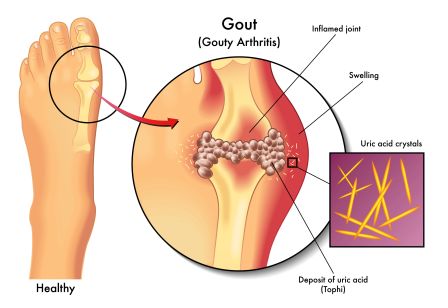
Gout causes
Uric acid concentration in the body fluids depends upon the balance between purine synthesis and uric acid elimination through the kidneys and intestine.

Various genetic and environmental factors lead to increased uric acid levels in the blood, either by decreasing the excretion of uric acid or by increasing its production. In about 75 % of patients, genetic deformity contributes to increased uric acid levels by decreased uric acid excretion through urine.
In about 25 % of patients, increased uric acid production is the cause for gout. In such patients, if the kidneys are normal, they excrete more and more uric acid through urine.
Factors influencing gout and increased uric acid levels in the blood:
- Renal failure.
- Drugs like diuretics, Pyrazinamide, and aspirin
- Lead poisoning
- Hyperparathyroidism (increased parathyroid hormone)
- Myxoedema
- Down’s syndrome
- Lactic acidosis by alcohol, exercise, starvation, vomiting and toxaemia in pregnancy.
Symptoms
Acute gout (sudden onset): the joint of the great toe, (metatarsophalangeal joint) is the site of a first acute gout attack in 70 % of cases. In the rest of the cases, it affects ankle, knee, small joints of feet and hand in the decreasing order of frequency. Sometimes the onset may be very sudden, waking up the patient from sleep. The affected joint looks red, hot, swollen with prominent veins, with severe pain. In some cases, it is preceded by nausea, lack of taste etc. If left untreated, it may last for a few days or weeks, and may also get healed by itself. But sometimes, this self-healing may lead to itching and desquamation of skin at the place (joint) of the gout attack.
Some patients may have only one attack in their entire lifetime, and many may have repeated attack after several months or years. An acute attack usually presents with features like cellulitis, synovitis, bursitis and tenosynovitis.
Acute gout attacks may happen repeatedly due to a sudden rise in serum urate following alcohol, severe dietary restrictions, diuretic drugs. Acute gout attacks may also be provoked by trauma, unusual physical exercise, surgery or severe systemic illness.

Usually, one acute gout attack may not lead to disability.
Chronic gout:
Recurrent gout attacks lead to chronic gout. It leads to erosion of cartilage and bones. Severe joint deformities are also seen.
Urate urolithiasis (formation of urate kidney stones):
This is seen in 10-15 % of people, usually in Gout patients from hot climates. Formation of urate stones is favoured by increased uric acid in the urine, purine overproduction, excessive purine intake in blood, low urine pH, as in chronic diarrhoea.
Chronic urate nephropathy: Gout and hyper uric acid levels in the blood are associated with kidney disorder. This occurs due to urate stone formation, kidney tube obstruction, and increased blood pressure.
Other disease manifestation:
Gout and increased uric acid levels in blood often associated with high BP, obesity, diabetes mellitus, ischemic heart diseases etc.
Investigations
Serum urate level increase is appreciable. But it is not the only diagnostic criterion. The clinical symptoms should also be taken into consideration.
Gout in Ayurveda
There are many joint related disorders explained in Ayurvedic textbooks, of which, grossly Vatarakta signs and symptoms can be co-related with Gout.

Herbal remedies
Ayurvedic herbal remedies for Gout:
Indian Tinospora (giloya) Most of the Ayurvedic medicines for Gout contain this herb.
Guduchyaaha swarasam choornam kalkam kwathameva va |
Peetwa kwatham asrugvatam kramaat sarvaangagam jayet || – Bhaishajya ratnavali – 27/10
Giloy in the form of water decoction, powder, juice etc should be used to treat Vatarakta (also called as Asrug vata).
A study conducted at the department of pharmacology Nagpur, has proved the immunomodulatory effect of Indian tinospora. Guduchi is also a proven anti-inflammatory agent.
Hareetaki:
Terminalia Chebula is used as an ingredient for many gout herbal remedies. A study conducted in pharmacology division of Visakapattanam has revealed the renoprotective (kidney – protective) activity of Hareetaki.
Ginger:
It is a proven anti-inflammatory and anti-arthritic drug. It acts specifically over affected joints to bring about quick relief from pain and inflammation. click to read.
Guggulu – It has potent anti-inflammatory action and is used in Ayurveda for arthritis conditions including Gouty arthritis.
Diet for Gout
Low purine intake, avoiding alcohol, gradual steps to decrease weight, helps in fall of uric acid levels. But severe dietary restrictions are best avoided.
Foods to avoid
Purine-rich foods – Beer, other alcoholic beverages, Anchovies, sardines in oil, fish roes, herring, Yeast, Organ meat (liver, kidneys, sweetbreads), Legumes (dried beans, peas), Meat extracts, consommé, gravies, Mushrooms, spinach, cauliflower.
Gout: Food to have
Low purine diet for gout – Rice, eggs (limited intake), Nuts and peanut butter ( limited intake), fat-free cheeses and ice cream, Milk: skim or 1% (limited intake), soups made without meat extract or broth,Vegetables not on the lists above, Fruits and juices, Breads and cereals: low fiber, white flour, or refined grain types, Pasta and macaroni. Rice, Soda, Coffee, dark berries, and tea.
Home remedies
Green gram soup,
kashayayam abhayaanaam vaa paayayet ghritabharjitam | – Ashtanga Sangraha chikitsasthana – 22/12
Decoction of Abhaya (hareetaki – Terminalia Chebula ), fried in ghee should be consumed followed by drinking of milk.
Dashamoola shataksheeram sadyaha shoolanivaranam |
Parisheke anila praaye tadwat koshnena sarpishaa || – Ashtanga Sangraha chikitsashana – 22/23.
Milk boiled with dashamoola (group of ten herbs), poured warm, over the affected joints gives quick relief from pain.
Similarly ghee, processed with Dashamoola.
Panchakarma for Gout: virechana and basti
Ayurvedic gout diet
Food to avoid –
Black gram (Urad daal), kulattha, Ayurvedic medicines containing ‘Kshara’, radish, alcohol, sugarcane, curds.
Activities to avoid – day sleep, exposure to direct sunlight.
Food to have in Gout:
Rice, wheat, buffalo milk, cow milk, Amla, Elephant foot (herb – sooran kand), bitter gourd, raisin, ash gourd.
Ayurvedic Natural Home Remedy For Gout [Video Tutorial]
Gout is often recurrent in nature. In Ayurvedic treatment of gout, correction of digestion enzyme levels, reducing pain and inflammation in the joints are given utmost importance. Home remedy plays a very important role in Ayurvedic treatment for this joint disease. Here is one such natural remedy.
Natural Home Remedy For Gout:
What you need –
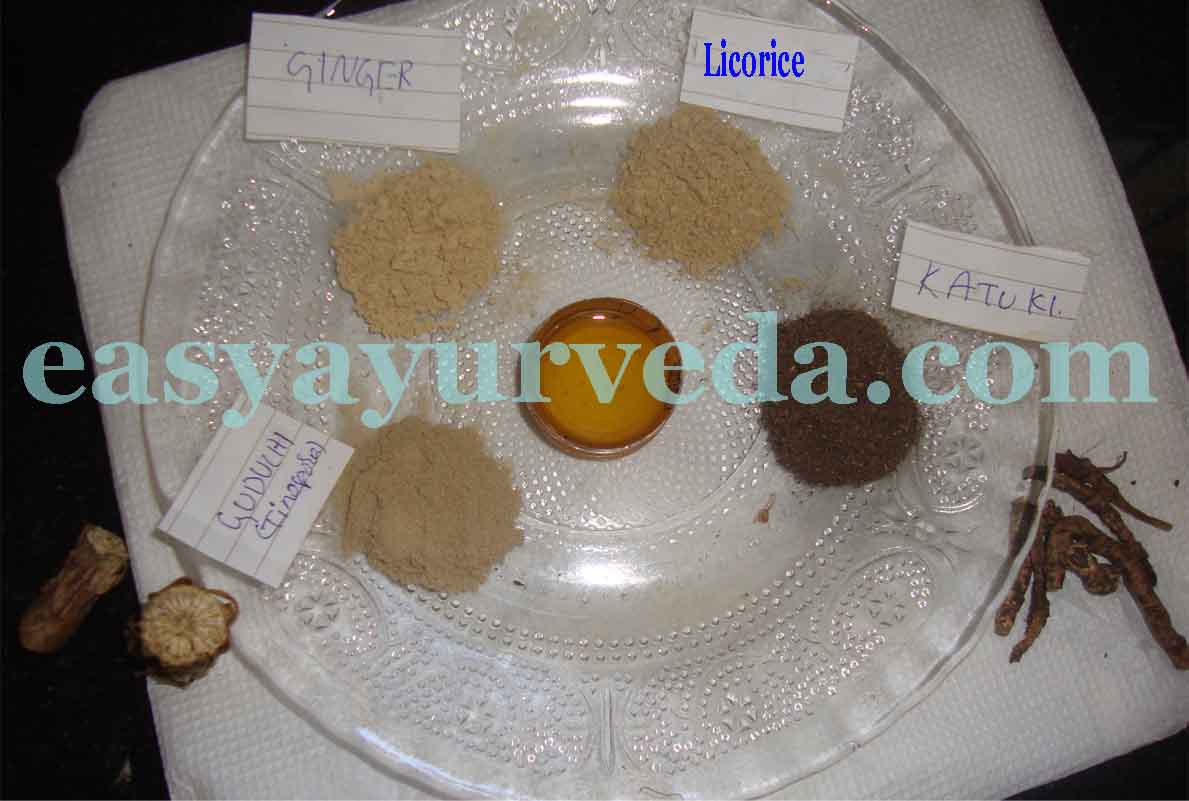
- Guduchi fine powder= Giloy = Indian tinospora – 10 grams
- Ginger powder – 10 grams
- Yashtimadhu = Licorice = 10 grams
- Katuki = Picrorhiza = Picrorhiza kurroa = 10 grams
- Honey – quantity sufficient
Procedure:
- Take a fine powder of the above ingredients
- Mix it well
- Add honey and make a paste.
Dose: This paste is taken in a dose of 1 – 2 grams in the morning and at night, after food, or as directed by your healthcare professional.
In Ayurveda, it is advised along with cow urine. Cow urine has special therapeutic benefit in cow. (read more about cow urine benefits). It can also be taken along with warm water.

How does it act?
- Guduchi has immuno-modulatory and anti inflammatory effect. It helps to relieve pain and swelling in the joints affected by gout – arthritis. Ayurveda explains Guduchi (Giloy) as the number one herb in the treatment of Gout.
- Ginger and licorice are potent anti inflammatory herbs.
- Katuki – helps to equalize the digestive and liver enzymes, responsible for inflammatory complex of gout.




10 comments on “Gout: Causes, Symptoms, Treatment, Home remedies”
Dr Sniktha prakash
Hello sir your articles are very informative thank u so much for your wonderful work.pl continue this work and a small suggestion cover the branches of kaumara and prasuthi.I am personally expecting articles from these field.you are flourishing our ayurveda thro articles good work sir keep it up
Dr J V Hebbar MD(Ayu)
Dear Dr Sniktha Prakash, Many thanks for your kind words of appreciation 🙂 Best regards, Dr Hebbar
sheeja paulos
Thanks for sharing such detailed informaion on gout it’s types and herbal remedies got to know all at one place. Keep up the good work.
Dr J V Hebbar MD(Ayu)
Welcome. 🙂
Shrinivasala
Thanx for the information Dr.
Deepanshu Manchanda
Dr hebbar,
You are really my go to doctor in Ayurveda. Your articles are so well written informative and easily understood. I really appreciate your effort and bless you from the core. May you have a long, healthy and purposeful life.
Keep up the good work.
Dr J V Hebbar MD(Ayu)
Thank you!
Shri kant
Sir ,
Your articles about ayurveda and ayurvedic disease are so useful… really so good…please make a app of easy ayurveda..that will really helpful for all..
Thank you
Dr J V Hebbar MD(Ayu)
Namaste! Many thanks.
Please go to google chrome on your android smartphone.
type easyayurveda.com and hit enter.
At the bottom, you will get an option to “add easyayurveda to your homescreen”
If you click that, the whole website turns into an app.
Please let me know if you get any doubts.